
Introduction
The Southern Thornlands Priority Development Area (PDA), located in the Redland City Council local government area, was declared by the Queensland State Government on 4 April 2025. Following public notification from 3 August to 15 September 2026, the Minister approved the Southern Thornlands PDA Development Scheme (the Scheme), which took effect on 23 October 2026. The Scheme replaces the Interim Land Use Plan (ILUP) that had applied since the PDA was declared.
What is a Priority Development Area (PDA)?
A PDA is an area of land designated by the Queensland State Government for accelerated development. PDAs are made under the Economic Development Act 2012 (Qld) and are declared by the Minister for Economic Development Queensland (MEDQ). When declaring a PDA, factors such as economic growth, the need for faster development, special purposes, unlocking unused government land and community benefits are considered.
What are the Effects of a PDA?
Once a PDA is declared, the planning framework regulating development shifts from the relevant Council Planning Scheme to the state-controlled PDA planning and assessment framework under the Economic Development Act 2012 (Qld). Development is governed by an ILUP until a development scheme takes effect, which for Southern Thornlands is now the case. Any inconsistency between a PDA scheme and other local or state planning instruments is resolved in the PDA scheme’s favour. The Redland City Plan 2018 cannot make development in the PDA assessable, although the Scheme adopts its use definitions and administrative terms and refers to parts of it as guidance material. Under a PDA scheme, the MEDQ must decide an application within 40 business days after lodgement and assessment. However, this timeline may be paused or extended if Economic Development Queensland (EDQ) requests further detail or if public notification is required (in cases of specific proposals).
In our experience, it should not be taken for granted that an application will be decided within that timeframe. Appeal rights are also different to a development application under the Planning Act.
The Southern Thornlands PDA
Background
The Southern Thornlands PDA covers approximately 890 hectares in the Redland City Local Government Area. It is bounded by Boundary Road to the north, Eprapah Creek to the south, Mount Cotton Road to the west and established residential areas to the east. It is intended to address future housing, infrastructure and economic needs. Under the Scheme and EDQ’s materials, the Southern Thornlands PDA aims to deliver:
- Around 8,000 new homes for approximately 21,000 Queenslanders, offering greater housing choice to the community;
- Approximately $565 million in trunk infrastructure (FY2026/27 dollars) under the Scheme’s Schedules of Works, including about $259 million in road and active transport infrastructure, $159 million for sewerage (including $109 million in sub-regional treatment and effluent disposal works), $30 million for stormwater, $23 million for water supply, and $95 million for parks and land for community facilities;
- Over 150 hectares of open space, including 11 neighbourhood recreation parks;
- Three new state schools: two primary schools (7 hectares each) and a secondary school (12 hectares), alongside the existing Sheldon College, whose intensification the Scheme supports; and
- Approximately 100 hectares of land earmarked for economic uses, including a District Centre, three Local Centres and an Industry and Enterprise Area, supporting local businesses and creating potentially hundreds of jobs closer to home.
Land Use Plan
The Scheme replaces the former Precinct 1 (early release area) and Precinct 2 (investigation area) structure with a single Land Use Plan for the whole PDA. Development is assessed against a Structural Elements Plan and PDA-wide criteria. The key elements are:
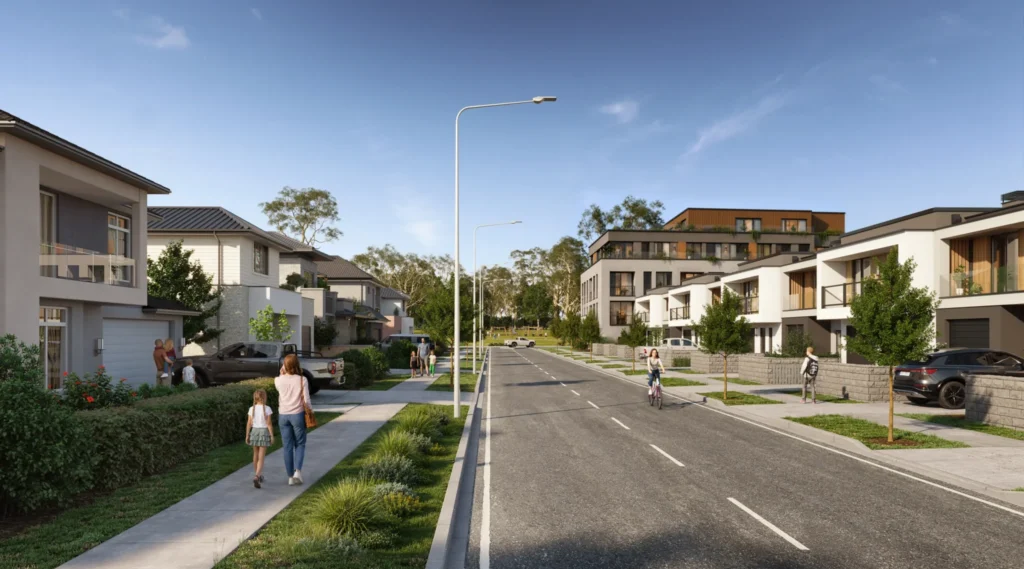
- Urban Living: neighbourhoods with a range of lot sizes targeting a net residential density of 25 dwellings per hectare. Secondary dwellings, dual occupancies, terraces and multiple dwellings of up to 3 storeys are supported, particularly near centres and schools. The MEDQ will also consider alternative solutions, including the new Queensland Housing Code, which commenced on 1 September 2026.
- Activity Centres: one District Centre (up to 9,400m² retail, 2,000m² office and 1,300m² health floor space) and three Local Centres (each up to 3,900m² retail, 1,000m² office and 600m² health floor space).
- Industry and Enterprise Area: located along Boundary Road and Mount Cotton Road, it accommodates low and medium impact industry, warehousing, service industry and complementary uses. High impact industry is excluded, and a 100m transition to Urban Living areas is required.
- Green Network: strategic ecological corridors with indicative average widths of 300m for the significant corridor (Eprapah Creek, of which 150m is within the PDA), 100m for moderate corridors and 50m for minor corridors. Core conservation areas and habitat investigation areas are subject to site-specific ecological investigation.
The Scheme does not identify any prohibited development. Development not listed as PDA accepted development in Schedule 2 is PDA assessable development. Accepted development includes development carried out in accordance with an approved Plan of Development. Interim uses may be approved where they do not prejudice long-term outcomes or infrastructure delivery.
Development Charges
The Scheme introduces development charges made up of a municipal charge and a sub-regional charge. The base rates are:
- $53,500 per lot for reconfiguring a lot, and per dwelling for residential dwellings with 3 or more bedrooms ($43,000 municipal and $10,500 sub-regional);
- $38,214 per dwelling for residential dwellings with 1 or 2 bedrooms; and
- separate rates for short-term accommodation and non-residential uses, the latter charged by gross floor area and impervious area.
These charges have been introduced through a separate infrastructure charging framework, with charges that are higher than the 2026-2027 state-wide maximum adopted charges for ordinary residential development in Queensland. This can be seen when comparing the prices in bullet points 1 and 2 above with the state-wide maximum adopted charges of $38,029.25 and $27,163.80 respectively. This is likely due to the significant trunk infrastructure required to be built to facilitate development of the PDA.
Charges are indexed each 1 July. Credits are available for existing lots and lawful uses, and offsets and refunds may apply where trunk infrastructure is delivered by a developer. Interim uses approved for less than six years are not charged. Not-for-profit and charitable organisations may apply for an exemption of up to $150,000 per application.
Next Steps
With the Scheme now in effect, EDQ will assess development applications in the Southern Thornlands PDA against it. The Scheme’s Implementation Strategy commits EDQ to work with Redland City Council, the Department of Education and the Department of Transport and Main Roads on infrastructure funding and prioritisation, a district sports park, sub-regional wastewater infrastructure, school delivery, and upgrades to Mount Cotton Road, Boundary Road and Duncan Road.
Conclusion
Milne Legal provides advice and represents clients in relation to a range of town planning and environmental law matters. If you have any queries or concerns regarding the Southern Thornlands PDA and would like to get in touch, please contact our office on (07) 3210 0943 or email us at admin@milnelegal.com.au.
This publication is general in nature. Its content is current at the date of publication. It does not constitute legal advice and you should always seek legal advice based on your particular circumstances prior to making any decisions relating to matters covered by this publication. Certain details may have been sourced from external references, and we cannot assure the accuracy or timeliness of such information.